How to choose a ceramic manufacturer in Thailand
Thailand has hundreds of ceramic factories. Most of them cannot make your product, and the ones that can are not all set up to work with an overseas brand. These are the questions that separate them.
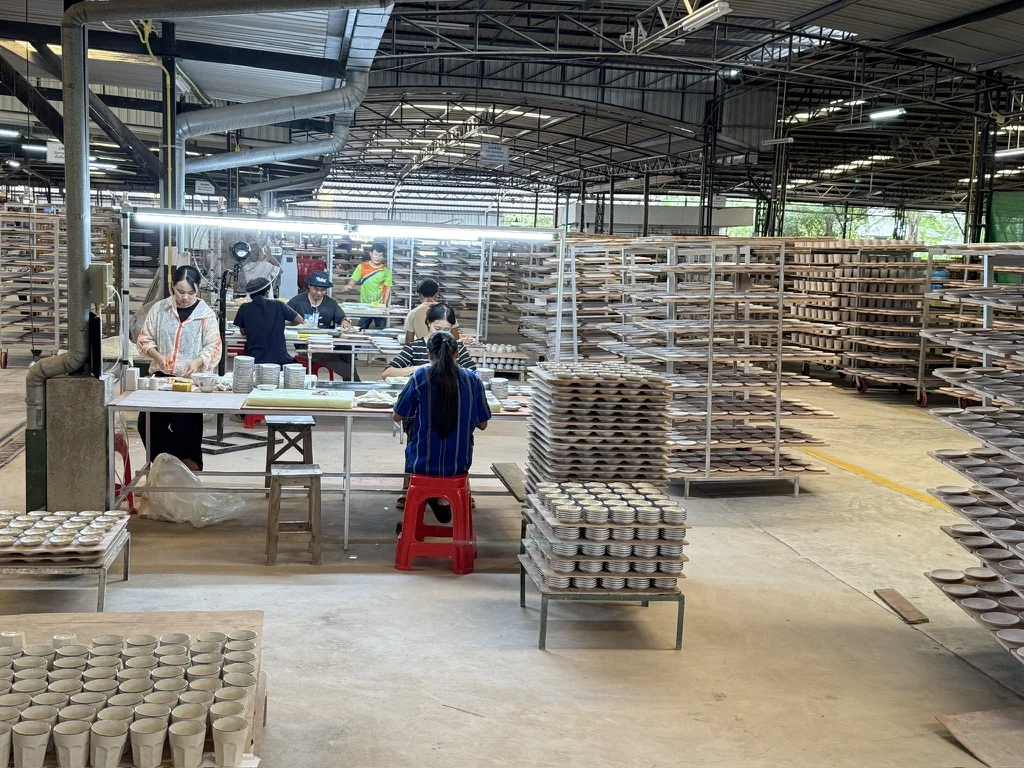
A factory that is right for one product is often wrong for the next. A press-forming plant that runs millions of plain plates is not the place to develop a sculpted handle. A studio that hand throws beautiful one-offs has no answer for a 1,000 piece repeat order. The first job is not finding a factory, it is describing your product precisely enough that the factory question answers itself.
Start with the forming method, not the factory name
Ceramic tableware is made by a small number of processes, and each one has a shape and volume it suits. Jiggering and jolleying turn flatware: plates, saucers, shallow bowls. Ram pressing and isostatic pressing do the same at higher volume with tighter tolerance. Slip casting fills a plaster mould, which is how handles, sculpted forms, teapots and any hollow shape with an undercut is made. Hand throwing is for small runs and for shapes that need a maker, not a mould.
If your product is a mug, ask which of those four the factory uses for the body, and whether the handle is cast and applied by hand. The answer tells you the tooling cost, the minimum order and the lead time before you ask for any of them.
Ask what they will not do
A useful factory tells you where its range ends. Reactive glaze needs a kiln with even temperature control across the load, otherwise the same glaze fires differently at the top and the bottom of the stack. Large platters warp if the kiln furniture is not set for them. Dark clay bodies show every speck of iron in the body and every mark on the mould. If nobody mentions any of this, you are talking to a sales office rather than a production team.
Six questions worth asking before a drawing
- Which forming method would you use for this shape, and why?
- What is the minimum order per design, and does it change with the number of colours?
- Is tooling quoted separately, and who owns the mould afterwards?
- How long does the first sample take, including revisions?
- Which compliance documents can you actually show for this factory, for this category, for my market?
- Who inspects the run, against what written standard?
The last two matter more than they look. Certification is factory specific, not company wide, so a certificate for another product line proves nothing about yours. And a production standard that exists only in someone's memory is the reason the second order looks different from the first.
Where working with the maker helps
A factory speaks in moulds and the brand speaks in samples, and most problems start where those two languages stop being translated. The useful arrangement is one team that quotes the tooling, holds the sample, writes the standard and stands on the line during the run. At Goodtogo Thailand that team and the line are in the same building: our factory in Thailand, our own mould shop, our own kilns, one contact for the whole programme.
If you want the short version of this checklist as a starting point, send us the product and the volume. We will tell you which process it belongs in before anyone quotes a price.